
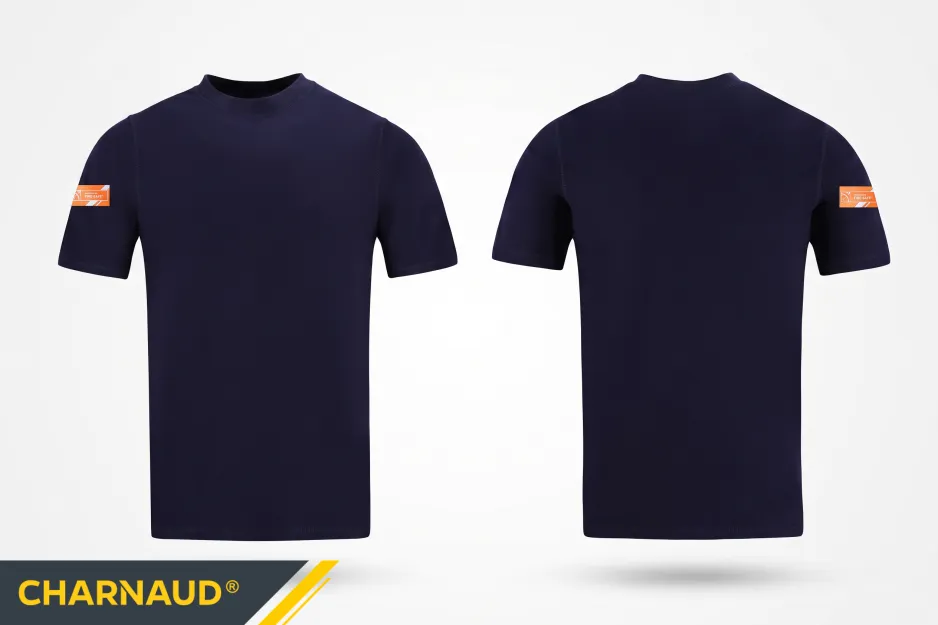
Summary: A fire-resistant (FR) T-shirt adds a layer of thermal insulation when worn against the skin, under your main industrial safety wear. Because a short-sleeve garment leaves the arms and neck exposed, an FR T-shirt should never be used as standalone protective equipment.
Its job is to be the certified protective base layer in a complete PPE system, replacing ordinary undergarments that could ignite or melt under extreme radiant heat.
Because they are made from inherently flame-resistant fibres, purpose-built base layers keep their protection, and it cannot be washed out. They work safely with heavy-duty outer garments in firefighting, smelter and high-voltage electrical settings.
Why Are Fire-Resistant T-Shirts an Important Base Layer in a PPE System?
Workers in high-temperature environments, from structural and wildland firefighting to metal smelting and electrical maintenance, often focus only on their outer garments. The layer against the skin tends to get less attention.
In short: a fire-resistant t-shirt is a certified protective base layer worn under your main PPE. It adds thermal insulation and stops the layer next to the skin from igniting, without limiting movement or breathability.
An FR t-shirt is not a standalone protective garment. Its short sleeves leave the arms, wrists and neck exposed to open flames, radiant heat and molten spatter. It does its job as the inner layer of a multi-garment system.
The CHARNAUD® FIRE-SAFE® and SURVIVE-ARC® ranges are designed to work with dedicated base layers, so protection is consistent from the skin outward.
Technical Performance Factors of Protective Base Layers
To judge an FR base layer, look at three things: the fibre it is made from, the thermal barrier it adds, and how well it works with the outer garment for your hazard.
1. Inherent Flame Resistance vs Plain Cotton Undergarments
A common belief is that a standard 100% cotton t-shirt is completely safe under protective workwear. It is better than a synthetic one, but it is not flame-resistant.
Untreated cotton does not melt and stick to the skin the way polyester or nylon does. But plain cotton is not flame-resistant. If it is exposed to high heat, or if the outer layer is breached, untreated cotton can ignite and keep burning.
Purpose-made FR t-shirts use fibres with permanent, inherent flame resistance. In inherent garments, such as those in CHARNAUD®’s protective range, the flame resistance is part of the fibre itself. This means it cannot be washed out by repeated industrial laundering, sweat or heavy wear.
2. Adding Thermal Insulation Through Layering
In a flash fire or thermal discharge, heat moves quickly through fabric toward the wearer’s body. Air trapped between layers slows this heat transfer.
An inherently FR t-shirt under an outer protective garment adds a thermal barrier. It helps reduce the heat reaching the skin, which lowers the risk of burns, and it helps manage sweat and moisture.
Adding an FR t-shirt under an outer jacket improves thermal performance, but it does not automatically double the ensemble’s cal rating. Overall protection depends on the complete system. What an FR base layer does give you is a layer next to the skin that resists ignition and will not melt or drip.
3. Pairing FR Base Layers With CHARNAUD® Outerwear Ranges
An inherently fire-resistant base layer works across several demanding industrial environments:
- FIRE-SAFE® Conti Suits: Under a two-piece suit, an FR t-shirt gives a safety buffer across the torso if the jacket shifts or comes undone during heavy manual work.
- FIRE-SAFE® Bunker Suits: Structural bunker jackets, such as the CHARNAUD® AIR-LITE®, have multi-layer shells. An inherently FR base layer sits comfortably under the thermal lining. It does not melt, and it does not restrict movement.
- FIRE-SAFE® Bushfire Coveralls: Wildland firefighters face long periods of radiant heat and heavy physical effort. Under a single-layer wildland coverall, an FR t-shirt adds thermal insulation over the torso while still letting air circulate.
- SURVIVE-ARC® protective garments: An electric arc flash releases intense radiant heat, so a non-FR undershirt that melts under arc gear is a serious burn risk. All CHARNAUD® SURVIVE-ARC® garments are permanently flame-resistant. Pairing them with an FR base layer gives a non-melting system from skin to outer layer for high-voltage switching work.
Key Fire-Resistant Base Layer Considerations for Industrial Workers
Safety managers should check the following when adding FR t-shirts to their PPE specifications:
| What to check | What it means in practice | Why it matters |
|---|---|---|
| Permanent inherent FR | The protection is part of the fibre, so it cannot wash out over time. | Protection remains consistent for the life of the garment. |
| Non-melting fabric | No synthetic fibres that can melt and stick to the skin in extreme heat. | Helps reduce how deep and severe burns are. |
| Pairing with outer layers | Works with Conti suits, wildland coveralls, bunker gear and arc wear. | Keeps thermal defence consistent across the whole. |
| Comfort and fit | Protects the torso while staying comfortable, breathable and easy to move in. | Workers in hot industrial and smelter environments are more likely to keep it on. |
| Moisture management | Draws sweat away from the skin during hard physical work. | Helps keep workers drier and more comfortable in the heat. |
| Washing durability | Keeps its shape and flame resistance through standard industrial wash cycles. | The garment lasts longer, so you get more value from your PPE. |
Frequently Asked Questions
Can a FR t-shirt be worn on its own as primary PPE?
No. A short-sleeve fire-resistant t-shirt leaves the arms and neck exposed. It should never be the primary protective garment for tasks that need full-body protection against open flames, arc flash or molten metal splash. It is designed to be an insulating base layer.
Why can’t workers simply wear everyday 100% cotton t-shirts?
Untreated cotton does not melt like polyester, but it can still burn. If extreme radiant heat gets through the outer garment, an ordinary cotton shirt can ignite and keep burning against the worker’s skin. An inherently FR t-shirt should stop burning once the heat source is removed.
Is it safe to wear an FR t-shirt under SURVIVE-ARC® electrical clothing?
Yes. We recommend a certified, non-melting FR base layer under SURVIVE-ARC® protective clothing. It adds an extra layer of thermal protection in an arc flash and means no synthetic fibres can melt under the outer garment.
How do you care for inherently fire-resistant t-shirts?
Wash inherently flame-resistant garments as the manufacturer’s care label says. Avoid chlorine bleach, fabric softener and starch, which can build up on the fibres and reduce the garment’s flame-resistant performance.
Partner with CHARNAUD® for Fire-Resistant PPE Solutions
CHARNAUD® is a leading global supplier of certified protective clothing for hazardous workplaces. From structural and wildland firefighting to oil, gas and high-voltage electrical infrastructure, our complete systems protect workers from head to foot.
Protect your team from the inside out with certified base layers designed to work with your primary safety wear.
- Read Next: Understanding the Risks of Poor PPE Compliance
- Discover More: Explore CHARNAUD® FIRE-SAFE® Thermal Protective Wear


