
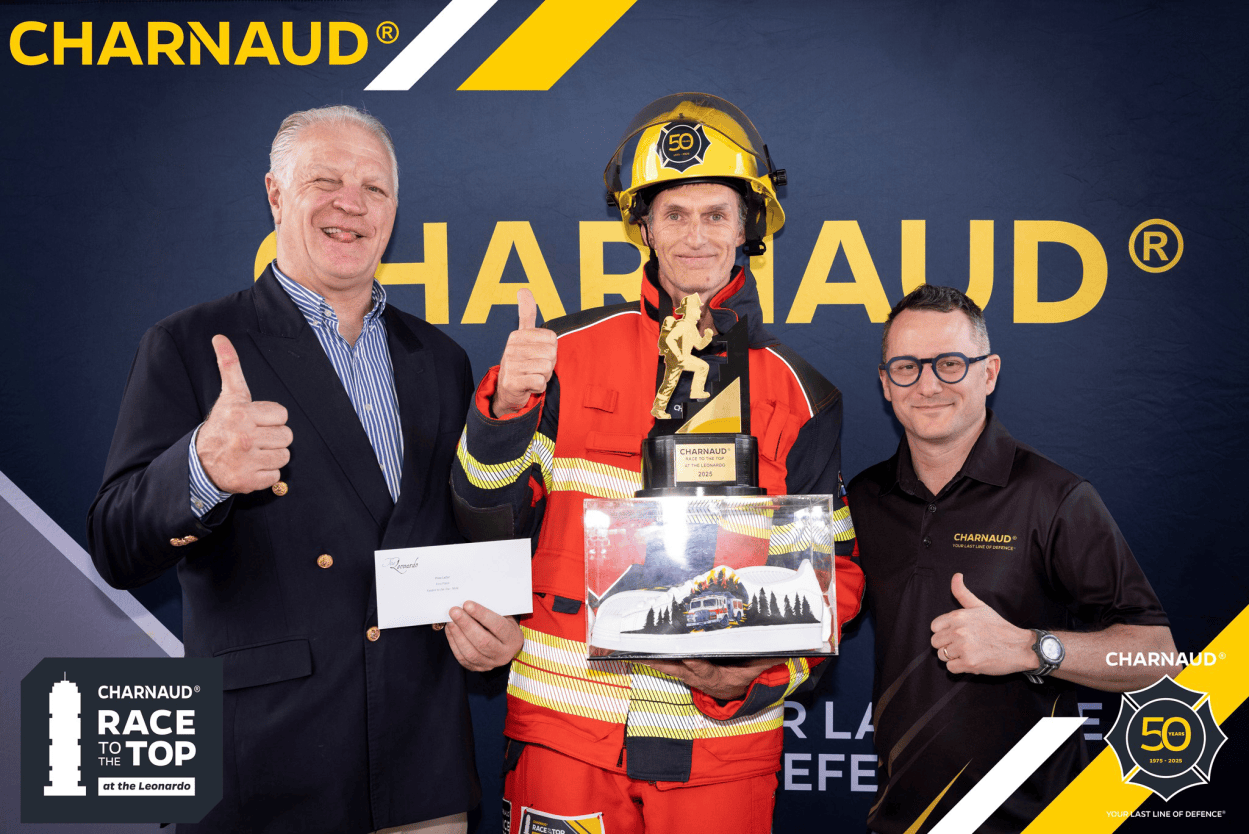
To mark over 50 years in business, CHARNAUD® hosted the Race to the Top, an endurance event in which 50 South African first responders climbed all 57 floors of one of the country’s tallest buildings in full protective gear. The event was designed to test strength and resilience, and to recognise the physical demands first responders face on the job. Manie Gouws, an ALS Paramedic and volunteer firefighter with nearly three decades in emergency services, came out on top. He has also competed at multiple World Firefighter Games and National Toughest Firefighter Alive (TFA) championships. We spoke to Manie about how he prepares for these competitive events, what his training looks like day to day, and why he’s trained in CHARNAUD® PPE for most of his career.
Background & The Job
Walk us through what a typical month looks like for you as a firefighter/EMS worker. What does the day-to-day involve?
Because we work shifts, it’s very important to plan, especially with family commitments. Sometimes unforeseen events will pop up and then you should be flexible. Weekends and public holidays don’t really exist for us, they are just another day, because when the family is at home you’ll be on shift, and when they’re at work or school during the week, you’re at home to do your everyday chores, of course.
With more than 25 years of experience, I can assure you that times have changed, but because we specialise in emergencies, it’s difficult to say that today will be a quiet or a busy day. You never know when a call will come in next or how long you’ll be out there. Weeknights are usually quiet while weekends are busy, but we’re always prepared, I usually tell the crew to enjoy the quiet days, because tomorrow we might not be so lucky.
For general firefighters: when you arrive on shift, all vehicles and equipment need to be thoroughly checked, because you don’t want to be stuck on a call with faulty equipment. After all checks are done and paperwork submitted, we clean the vehicles and equipment at the station before getting some down time, whereafter operational training needs to be done. There are also occasional school visits to educate kids on safety, and if time permits, physical training too, though that depends on the person and how they want to use their down time.
What’s the most common misconception people have about what firefighters and EMS workers do?
The most obvious is that we rescue cats from trees, because people see it in the movies. They think firefighters only fight fires, whereas we’re also qualified for rescue and medical emergencies, meaning we respond to motor vehicle accidents and various rescues and disasters. People think firefighters should be big, muscled bodybuilders and miracle workers, whereas we’re only human, with a passion for what we do.
Training & Fitness
Fitness is clearly critical in your line of work – what does your personal training schedule look like?
I’ve been a runner for most of my life, so I like to do at least one long run, one short run, some interval training, and an easy run during the week. Since I got involved in firefighting competitions, I realised I also need to do some functional and strength training during the week as well.
Because we work shifts, we really need to plan properly and make use of every moment we have to fit in a session. I don’t train at a gym or CrossFit centre, my weights and functional training happen at home. Sometimes it’s just a quick weight session and some sit-ups after a shift before supper, or a quick, fast run before a shift in the mornings.
On my off days, I like to run early in the morning so I can have the rest of the day for my day-to-day chores, then do some strength training at night. I’m currently coaching the N’zuri Westrand firefighter team, and I join them at least twice a week for fitness, endurance and functional training, at least 2 hours each session.
How does your fitness training differ from what you’d do purely for recreation? Is it more functional, more intense?
More functional and more intense. I try to recreate the course, with some improvisation, to imprint it into muscle memory. I push myself very hard with limited rest time, it just seems to work for me. For recreation, I like to do a long, easy run without a watch or timing device.
What happens physically on a job if you’re not fit enough? Can you give us a sense of the real stakes?
To start with, the gear and tools are heavy, and the demand is physical from the get-go. As soon as you start working hard under stress and pressure, your heart rate goes up, your muscles demand more oxygen, and your lungs yearn for more air. As you get tired, that demand keeps increasing, which leads to faster, more shallow breathing, this can be toxic to your body. Your muscles won’t get enough oxygen to perform as they should, which can lead to muscle cramps, poor concentration, even fainting.
On the other hand, if you’re fit, you’ll be able to regulate your breathing and heart rate under physical stress, because you’ve learnt to do it during training, and your muscles will get enough oxygen to perform optimally. Should you push yourself somewhat beyond your limits, your body will be able to endure it, because you’ve conditioned it with tough workouts and physical training.
What are the biggest physical demands of firefighting that most people wouldn’t expect?
People think it’s just putting out a fire quickly with water, but what they don’t know is that a firefighter needs to carry protective gear weighing some 15–20kg extra, just to protect themselves from harm. The extreme temperatures, and the loss of senses like touch, hearing and sight, are just some of the things people don’t realise happen when you enter a burning building. Firefighters need a sixth sense, so to speak, to overcome these physical challenges.
Balancing Training With the Job
How do you fit serious training into a schedule that’s already demanding — shifts, call-outs, recovery?
Sometimes it’s difficult to get a session in at work, depending on whether the shift is quiet or busy. For the fire crews it’s easier: they get more off time, and if they train in their kit, they’re already dressed for a call. Paramedics aren’t so lucky, they always need to be in uniform, so they can only train on their off days. Firefighters who train on shift should train cautiously and not overexert themselves, because you don’t know when a call will come in. The vigorous, tough training should be left for your off days, and you can do functional training on shift.
For the average firefighter who just wants to keep fit for day-to-day work, I’d say it’s easily possible, they have enough down time for at least an hour of training on shift, station dependent, of course. But it comes down to self-control and perseverance to keep it going as a daily routine.
For the rest of us who go the extra mile to compete in firefighting competitions, it’s somewhat different. While others train for an hour, you push for two; when others go home to their family, you hit the road or the gym for a quick session, pushing harder and faster each day.
Does your department support fitness, or is it largely self-driven?
It’s self-driven. Although departments support fitness, and it’s a requirement for recruitment, operational and financial demands get priority. They have limited -if any, fitness programmes in place, and it’s not compulsory at a lot of departments.
Training in CHARNAUD Gear
When did you first start training in CHARNAUD® PPE, and what prompted it?
Since I started in the service in 1998, I was issued a CHARNAUD® kit and never looked back. I’ve had a few other kits, but the CHARNAUD® kit was always my go-to for training and competition, because it’s lightweight, flexible, and easy to move in.
How does training in full gear change the experience, mentally and physically?
It was a huge mind shift – I had to start slow and work my way up to longer, tougher sessions. At first, I thought it would be easy, but my body disagreed. The kit being lightweight and easy to move in made it a lot easier, and it didn’t take too long to be in full swing of things. Now I’m like a racehorse, so to speak – as soon as I put on the kit, I just want to go!
What have you learned about your own limits from training in CHARNAUD® equipment?
I’ve learned that there’s no limit anymore. I was able to run faster and move with more ease.
Is there a specific piece of CHARNAUD® gear that’s become essential to how you train or perform on the job?
The boots. The CHARNAUD® boots make a huge difference. I used to wear and train in the old fire boots, but since switching to the CHARNAUD® boots, my training has become so much more enjoyable, because they fit comfortably like a shoe, not a boot. Super comfortable. If I could, I’d recommend these boots to every department, for every firefighter.
Closing
What keeps you motivated, both in the gym and on the job?
Firstly, I believe my work is a calling, and my ability to train is a gift from God. He gives me the strength each day to get up and go to work, and no matter what I face at work, I know God is always with me – to guide me, protect me, and give me strength.
Secondly, the support my wife has given me over all these years has kept me going.
Thirdly, I love coaching team N’zuri, and I’m proud of them. They keep me young, and I enjoy giving back to the younger generation. I’m excited to see what the future holds, God willing.
What advice would you give someone thinking about becoming a firefighter?
If it’s in your heart, and you can’t see yourself doing anything else, then go for it with all your heart. But before you decide, volunteer for a few shifts at a fire station and see what it’s all about – the good and the bad. Don’t do it for the money; the salary is only average. It has to be your passion, otherwise you’ll be disappointed and miserable at work.


